


![[VIP] Unlimited Pass 2026.02.26](https://i.pinimg.com/1200x/d2/f8/2e/d2f82e903b9ca33b0f13704cc85a3d8a.jpg)
![[LS] ls.graphics Pass 2026.02.16](https://i.pinimg.com/1200x/8d/ca/7f/8dca7ff72d8b698f955649340d0ff398.jpg)

![[PRO] Craftwork Pass 2025.06.11](https://i.pinimg.com/1200x/98/d2/f0/98d2f0169226b431f4727441ecc6aa06.jpg)


![[VIP] Spentra: Expense & Budget Tracker App](https://i.pinimg.com/1200x/8f/5a/79/8f5a7990421614a93e7fb21509f63c80.jpg)
![[VIP] Creovo: Creative Portfolio](https://i.pinimg.com/1200x/92/5d/39/925d39b614ae4e39adda25b73837f82b.jpg)
![[VIP] Eventverse: Event Organizer Framer](https://i.pinimg.com/1200x/5c/c0/2a/5cc02ad5be57bcf560611178f9914a58.jpg)
![[VIP] Fuchsia: Web3/SaaS Framer Website](https://i.pinimg.com/1200x/36/6c/37/366c371285f13531caf2077c599fa1cc.jpg)


![[VIP] Voltz: Electric Car Website Template](https://i.pinimg.com/1200x/03/ba/41/03ba41513483727fcd26b95349750783.jpg)
![[VIP] Zyra: Coded Chat AI Dashboard](https://i.pinimg.com/1200x/ce/7b/92/ce7b926f22423fc046659dfe1dd7a604.jpg)
![[$] AlignUI: Code Library](https://i.pinimg.com/1200x/8d/91/1c/8d911c0a22483842cff69c130e80c37b.jpg)

![[VIP] Solaris: Sales Forecast & Pipeline Review Deck](https://i.pinimg.com/1200x/ba/7c/48/ba7c485ac40a51054cf9074aead204e2.jpg)
![[VIP] Brand Guideline Presentation](https://i.pinimg.com/1200x/64/87/a7/6487a7c4da21072150a1664f83a6a234.jpg)
![[VIP] SaaS Pro: Presentation](https://i.pinimg.com/1200x/d5/75/dc/d575dc20daed5af02a08ed54d53ce7f5.jpg)


![[LS] iPhone 17 Mockup](https://i.pinimg.com/1200x/18/42/c1/1842c11e3da971765bdcfbc5315f3df8.jpg)
![[LS] iPhone 17 Pro Max Mockups](https://i.pinimg.com/1200x/f0/2a/72/f02a724ed9f52ac4a1c66b5614809111.jpg)
![[LS] AE-Mockups, Apple Devices](https://i.pinimg.com/1200x/03/04/9b/03049ba79acaa546ae6389639f89bcc1.jpg)
![[LS] MacBook Air M2 Looped, Animated Mockups](https://i.pinimg.com/1200x/76/d9/0a/76d90af27052b69cb561a098cd1907a6.jpg)


![[VIP] Volnitsa: BLNDR MINI (2025)](https://i.pinimg.com/1200x/c3/f7/0a/c3f70ae1126be5c0af1977e58b56ba7a.jpg)

![[VIP] Build End-to-End Products in Cursor without Coding](https://i.pinimg.com/1200x/0d/6a/0c/0d6a0c8b37256206e98aed50719cf638.jpg)
![[VIP] Growth: The Psychology of UI Design](https://i.pinimg.com/1200x/3a/d1/b5/3ad1b5e63efe17451a16013591bcf519.jpg)


![[VIP] React Three Fiber: The Ultimate Guide to 3D Web Development](https://i.pinimg.com/1200x/78/02/1f/78021ffdfc8113cc8caba5b2c563ead4.jpg)
![[VIP] Ryan Hayward: Ultimate Framer Masterclass 3.0](https://i.pinimg.com/1200x/48/d6/3f/48d63f9723d7c49e6c34c182557c7431.jpg)


![[VIP] Whoooa! 156 vector Lottie animations](https://design.rip/uploads/cover/blog/whoooa-156-vector-animations.webp)


![[VIP] Staff Product Designer (ENG, RUS)](https://i.pinimg.com/1200x/0c/52/a0/0c52a08d8b0a25329806437933cf538f.jpg)


Vibe Coding is OVER.
Design is dying in 2026 – unless you stop vibe coding and start thinking like a real designer.
Design in 2026
Take a look at these three landing pages. What do they have in common? And most importantly: will you remember any of them 30 minutes from now? All were made extremely fast.
This isn't variety. This isn't a brand voice. It's converging websites into a commodity. Everyone's work is becoming an equivalent of the famous Ikea LACK coffee table. With sawdust filling inside a plastic wrap.
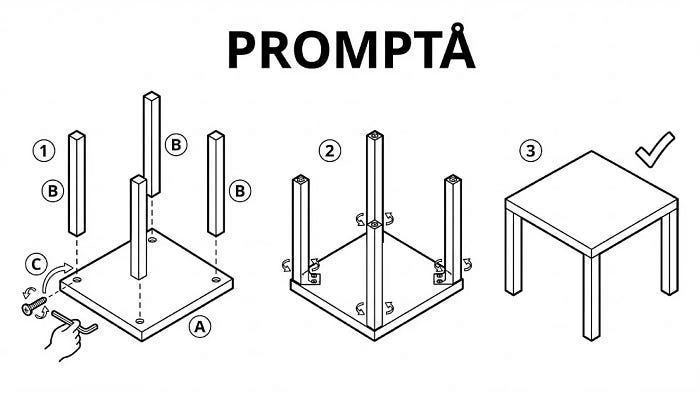
An AI generated table would probably be called PROMPTA
It's functional, but soulless. It blends into the background, obstructing the message in the process. Nobody knows what you sell. Nobody cares. Another blob in the header with seamless streamlined effortless automation.
We're at a point where we out-vibed sanity. I don't even mean slop anymore. It's more like SPAM. When everybody can build without effort, the value of building also decreases.
The mythical "end consumers" are already overwhelmed. There's exactly 192 of anything. And by the time you read this article it's gonna be 193.
Chances ANYBODY needs your brilliant idea are extremely slim. People just don't care.
Overabundance led to desensitization. Most SaaS is actually useless. At least 60% of all "SaaS products" will be built into main AI tools by next year. Nobody needs another app.
Most people should just stop building.
But if you're not most people, read on.
It's not about AI
And you probably think I'm going to blame AI here right away.
No. I have a different theory.
People lacking the foundational knowledge, trying to do things "the fast way" were around way before AI. I started designing in the late 90s. We already had slop back then, when the internet was barely even born.
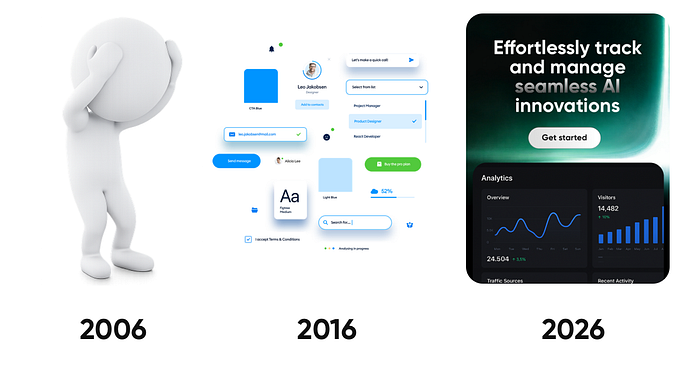
Slop across the ages
Then flat design, systemic components and figma happened. Suddenly people who could barely sketch a rectangle on a whiteboard that looked straight were doing UI. Auto-layout made them think it now "looks good" because it auto-aligns.
These people didn't even notice when auto-layout failed.
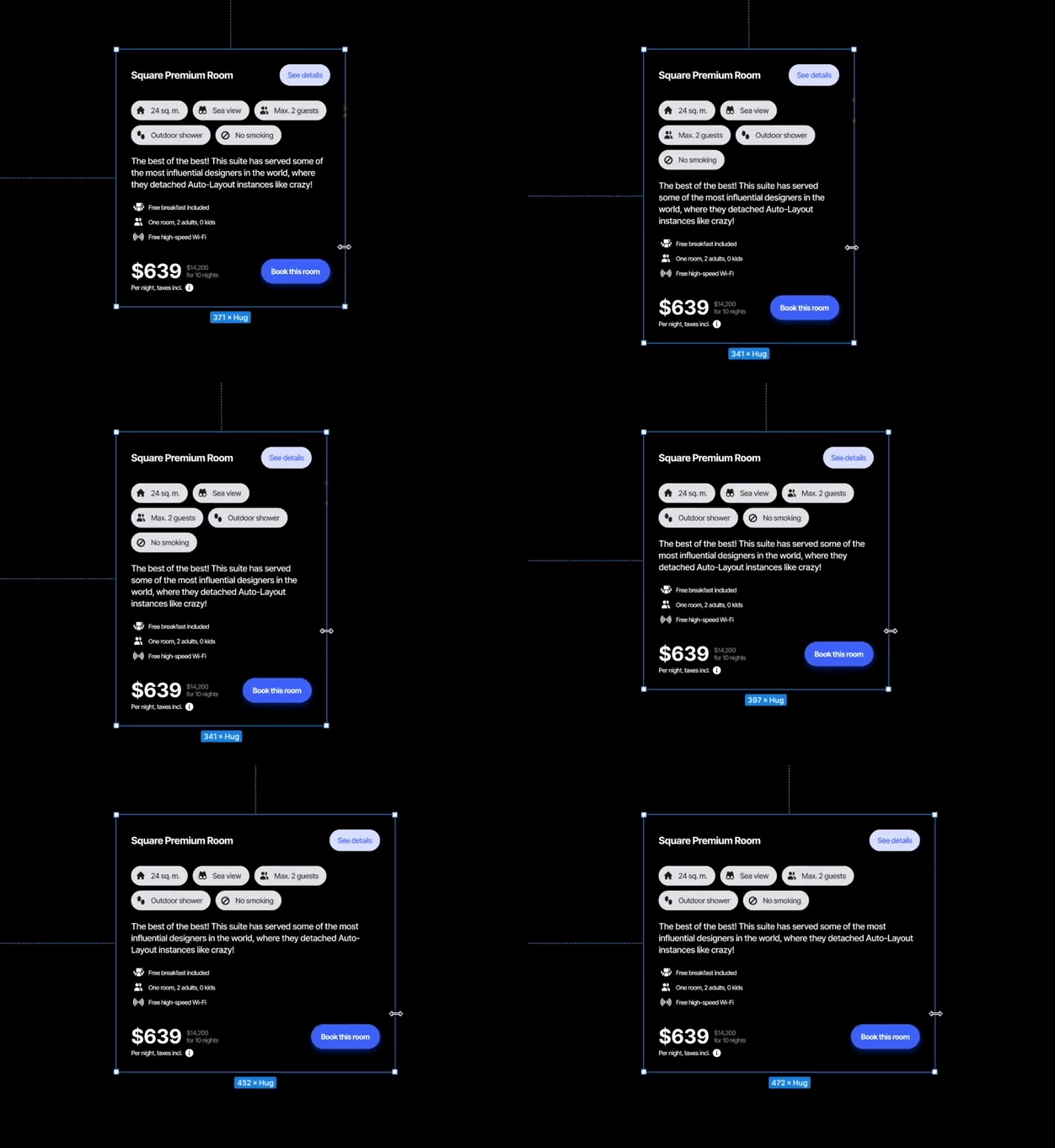
Best way to not understand what you're doing
They had no foundation. No eye for design. Or better yet. No love for design and no interest to learn.
It's optimization eating its own tail. People with no skill can do things faster now, and these things look passable at first glance. So we get more things being done.
It's not just design either. Most of these products don't solve an actual problem. Most don't communicate what they do. Hiding behind jargon. Buzzwords. That all existed for decades.
And then in 2023...
Hello, AI
Then AI came along and widened that no-skill group even more. Now you don't even need to know how to draw a vector rectangle. What a css class is. You type what you want into a box, add "and make no mistakes" at the end and press enter.
Then you sit back, holding your chin like the famous Steve Jobs promo pic. While in reality it's more akin to the one from Silicon Valley. But in this case they all have 10 fingers on each hand, because well… AI.

Everyone's an innovator, even if the fingers aren't quite right.
When the craft is gone, alongside curiosity, passion and heuristics, we're left with generism. And this generism is of the most nasty kind, as it pushes ugly, poor quality products out there.
It basically lowers the bar. And after years of templates and flat components trust me, it's already low enough.
It's more algorithmic sameness. Tools process the average work and create an average of an average. It dilutes the middle point. Sure, there's less horrible websites now, but also much less inspiring ones that you remember.
Quality got averaged exactly to the median. And then the numbers exploded inflating that middle ground enormously. There's maybe 1% bad websites out there, 1% good ones and 98% of the wide-average.
This has huge economic ramifications too. We'll get to those.
But ask yourself: When was the last time a clearly AI generated product surprised you? Do you even remember using any of them? Or do they fade into obscurity the moment you switch off?
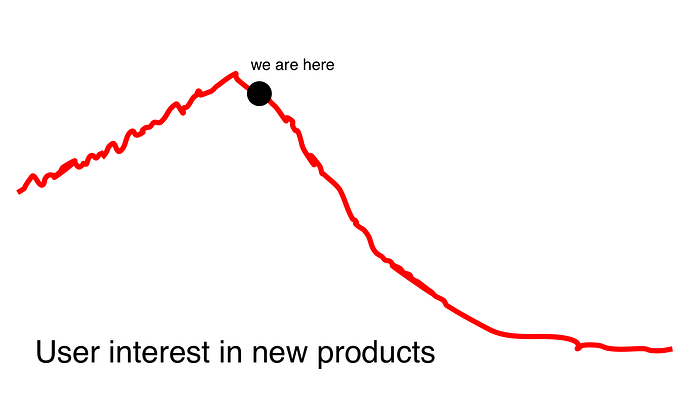
2023 was the last year people CRAVED more products, apps, things
Everyone's Barry Allen now
The obsession with speed is of course a part of the strategy of the AI companies. Most of the CEO's constantly yap about "getting your products out ASAP, as in 2 years coding will be extinct". They inflict that sense of doom for short term gain. Hoping more people will pay them $200/month and maybe one day they'll break even.
Their future is looking more bleak for them, than for us, smaller creators. We can always switch to cheaper or local models. They are stuck trying desprately to lose as little money as possible.
But they inflict the fear of missing out. And that fear drives the obsession with overshipping.
Partially, startup founders are also responsible, as they give the same advice over and over.
Ship fast, refine later!
And sure. MVPs can't take year or even months to make. You need to ship fast. But there's something I noticed back in 2017 about MVPs. Most people think it just means a Minimum Viable Product. But I'd expand it also to "Minimum Visible Precision".
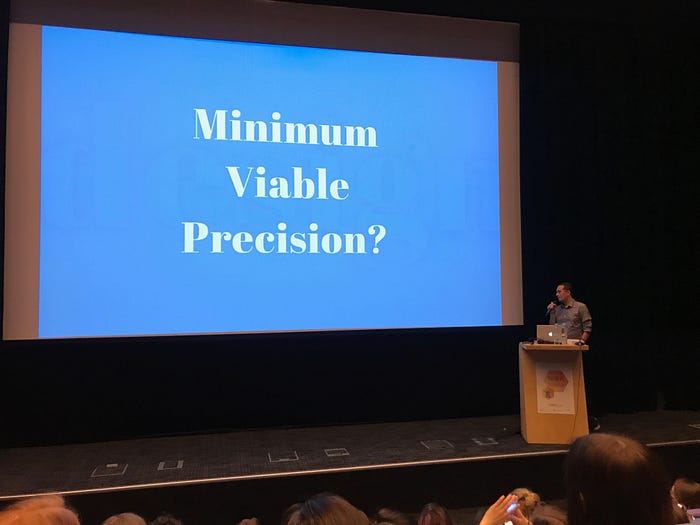
Much younger me, on stage almost 10 years ago talking about why quality matters in apps
However, right now, with AI tools, you can speed things up so much, that not getting to the minimum visible precision is not a time constraint. It's being lazy. Sloppy. Not detail oriented.
But AI can make code and video!!
Many people tell me replacing the frontend and design is coming soon. The reason they give is that AI can already code and there are examples of hollywood level AI generated movie fragments out there.
What they fail to realize is that that great code and those professional like movies weren't made by a single prompt by some guy in a basement.
That movie-like quality was achieved by actual filmmakers. With taste and skill in the craft. With insane attention to detail. Able to articulate what they want precisely AND knowing why they want it.
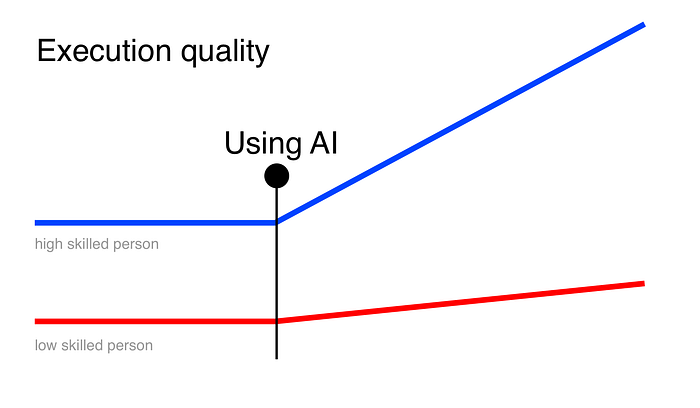
Just using AI has very little effect if someone is low skilled. High skilled people can benefit a lot more.
In all of these cases, design included, the AI is just a tool. And a mediocre person with a great tool still gets a mediocre result. If even that.
Let's examine the biggest problems first, and then I'll show you a solution. Not a hack. Not a pack of prompts that will save your app. A solution that requires your time and effort.
But that's the only way. You're not going to vibe your way out of this.
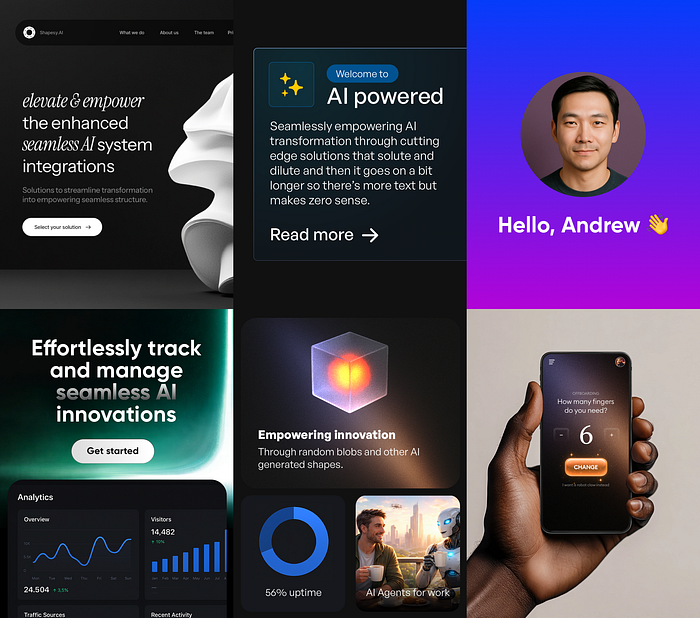
Typical examples of AI slop
Slop Shop
The slop is everywhere once you know how to spot it. It's the SaaS landing page with the gradient text hero that says "Revolutionize Your Workflow" followed by three feature cards with Lucide icons, a testimonials section with headshots from obvious stock photos, and a pricing table with three tiers where the middle one is highlighted as "Most Popular."
It's the AI-generated app icon that's a geometric abstract shape in purple-blue gradient with glassmorphism on top. It's the dashboard that displays 47 data points at once because more is better, right?
It's the chatbot interface that looks exactly like every other chatbot interface because the AI trained on every chatbot interface and spits out an average. The slop isn't necessarily ugly or extremely bad. It's just low effort and consumers are starting to feel it. The window for when the cheap + fast execution can still sell is narrowing.
It's just low effort and people feel it.
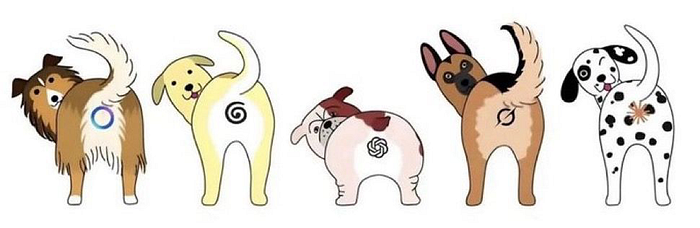
AI tool logos look kinda weird if you think about it
Tool obsession
Obvious fomo from trying to stay on top of the latest things prevents you from figuring out a quality solution to a problem. You get preoccupied with things you don't control like tools from other companies. You don't need the latest AI model to do great things. You need the right mindset to do great things.
The FOMO is real and it's paralyzing.
Every week there's a new model, a new framework, a new "game-changing" update that promises to 10x your work.
You spend more time watching videos, reading articles and comparing benchmarks than actually building. You subscribe to AI tool newsletters that tell you about other AI tools. You follow founders on X who post screenshots of their "stack" like it's a personality trait.
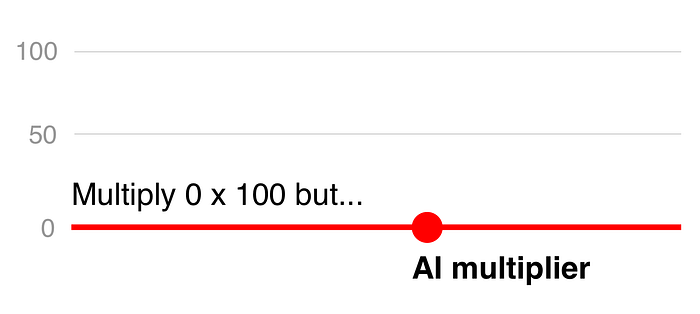
If you multiply 0 skill by any number you still get 0
Let's get this straight.
The tool doesn't matter. The person using it matters. A great designer with Figma from 2019 will destroy a mediocre designer with the latest AI-powered design tool from 2026.
The tool is just a multiplier. If your base is zero, multiplying it by any number still gives you zero. Stop optimizing your stack and start optimizing your taste.
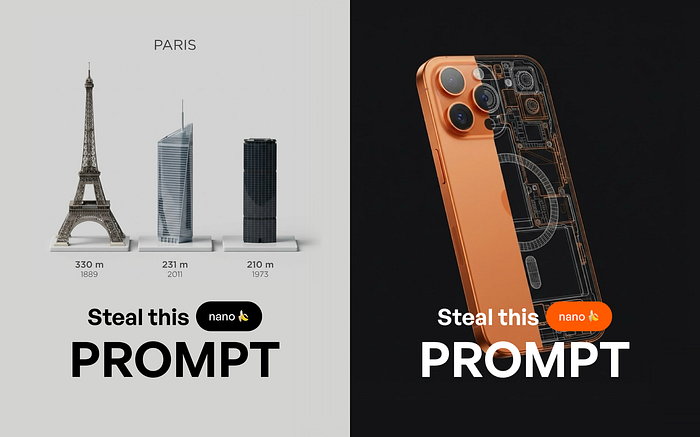
I made two joke posts called "Steal this prompt" and 300K people took the bait! It's scary!
Prompt hoarding
People save prompts for no reason. They bookmark, save and then never come back to them. Many lose the ability to describe things themselves because they're so used to grabbing pre-made assembly instructions.
Builders are getting dumber. It's harder for them to express what they want. Regular people seem to be even more lost in all that chaos.
There's a weird phenomenon happening where people treat prompts like magic spells. They collect them in Notion databases, share them in Discord channels, pay for "prompt packs" that promise to unlock the AI's full potential. It's a scam.
When I did my little experiment with just two posts, 300K+ people wanted them. Even though the prompts were pretty useless.
I even wrote "Comment PROMPT if you're stupid" under one post and hundreds of people, running on autopilot commented PROMPT.
That is the stage we're at
Prompts are just instructions, and if you can't articulate what you want, no amount of prompt engineering will fix that.
If you can't explain why you want something a certain way it's because you've never took the time to think about it.
It's like outsourcing outsourcing taste and creativity to a CSV file downloaded from a Gumroad page.
The builders who survive this era won't be the ones with the best prompts.
They'll be the ones who never needed prompts in the first place because they could already say what they wanted. Clearrly.
The fix
There are a couple of things that you need to do to get over AI slop and solve this problem. Let's go through them one by one.

Write things down on paper before jumping into tools!
Know WHAT you're doing
When planning a new product, write out what problem it solves. Then what the competitors are doing. Then what are the potential issues you can face when building. Plan every little detail.
Take a step back and ask yourself questions about your own idea.
A lot of current builders want "an app to do X" and just tell that to AI. That's an idea-slop built on top of design-slop with likely code-slop to match.
Projects like that will fail. You'll just waste AI credits.

Apple was inspired by Braun, but clearly took that inspiration and brought its own flare into it making timeless classics.
You need to see
Most people don't have an eye for design. Mostly because of lack of interest. Lack of critical thinking. And not seeing lots of designs for a long time. Not exploring.
The future is for the curious. Analyze great apps that you use. Try to understand WHY they're great. Down to every little button. Why is it there? Why is the label what it is? What happens next? Then read case studies. Be inquisitive.
That helps you to develop taste.
Get inspired by seeing how others get inspired. Apple took some cues from Braun's designs, but made those designs clearly theirs. Even just getting to know how this process works is already putting you ahead.

Just read a book on the basics. Trust me, you'll need it!
Fundamentals don't lie
Even if you plan on just vibing mini apps with AI, you need to learn design fundamentals. Typography, spacing, hierarchy, color theory. Understand why something works, and something else doesn't even if they look very similar at first glance.
Slow down
You can already code much faster than before. Use that extra saved time not to do MORE stuff. Use it to make better stuff.
Think about finding new solutions to old problems. Figure out little delights. Obsess over polish all across the product.
Own the decisions
Don't outsource critical thinking to AI. Have it execute a plan, but don't ask it to write the plan for you.
When you give away control, you're the redundant part of the equation. And the result has nothing unique in it.
Be aware of the economics
Shipping fast is already happening anyway. But you don't need to 10x. Go 2x but with extreme polish, attention to detail, security, code quality. Don't go for lazy prototypes and call them products.
There's an argument going around that most companies will be fine with fully generated apps and websites. That cheap and fast is better for their bottom line.
There are two things necessary to consider here.
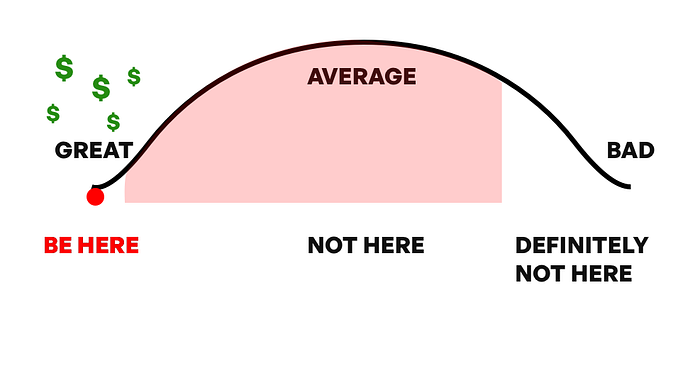
Average products have a short lifespan and less future revenue
Product value and market saturation.
I always said that if your product has value, everything else is secondary. With ultra high value you can skip great UX, people will literally jump through flaming hoops of horrible design and code just to use it. But the value must be clear.
For most products it's not. Most products need to fight for attention.
Market saturation means that while we raised the bar for how things look and work a while ago, it inflates the "average".
Once everyone has a similar, average website, with similar perceivable value, the consumers will go to those who value quality. Who show they took effort.
So going fast and cheap now, can cost you huge revenue drops in the future. It will work for some, sure. But I wouldn't count on it for every business.
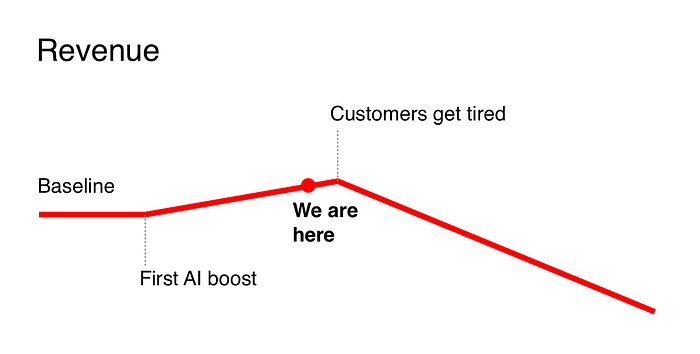
AI can boost you a little at first, but then it'll get worse
Conclusion
Vibe-coding isn't going anywhere. The tools will get better, the slop will multiply, and the pressure to ship faster will only intensify. Burning those credits is what the AI companies want. So they will push vibe-coding and vibe-building as a way of life.
It's not about people using AI vs people NOT using AI. That's boring.
It's about craft vs. convenience. The tools are neutral. The intent behind how you use them matters.
Everyone's Barry Allen now. Everyone can move fast. But speed without direction is just running in circles. The Flash can vibrate through walls, but he still needs to know which wall to go through. Some walls have lava on the other side. Some are too thick.
When you remove the friction of learning, you also remove the friction that forces you to think. And thinking, really thinking about what you're building and for whom, is what separates great products from forgettable ones.
Your vibe-coded app isn't worthless because you used AI. It's worthless because you never really put much effort.
The bar was already low after years of templates, flat components, and design systems that prioritized consistency over character. Cheap work was everywhere. Both how it looks and how it works felt cheap.
By not caring about quality, you simply picked your spot on one side of the "average" bell curve.
Opportunity knocks
When everything looks the same, true craft stands out. When everyone's shipping the same gradient-text hero section with the same three feature cards, the person who actually considered the user journey, who noticed the misaligned spacing, who cared enough to iterate past the first "good enough" wins.
The window for "it works, was fast and cheap" is closing.
Consumers are getting better at spotting slop. The founders who build real businesses will be the ones who took the time to learn, who noticed how AI got things wrong. Active, not passive.
They're the builders, AI is the tool.
When it's the opposite, products will fail.
Learn the boring stuff. Develop your eye. Care about the details that don't show up in metrics but show up in experience. Because when the slop tsunami finally recedes, what's left standing won't be the fastest. It'll be the best. Everyone else will be too boring to matter.
(I acknowledge some businesses are fine with boring products.)
What's Your Reaction?
 Like
0
Like
0
 Dislike
0
Dislike
0
 Love
0
Love
0
 Funny
0
Funny
0
 Angry
0
Angry
0
 Sad
0
Sad
0
 Wow
0
Wow
0


