
![[VIP] Unlimited Pass 2026.03.27](https://i.pinimg.com/1200x/d2/f8/2e/d2f82e903b9ca33b0f13704cc85a3d8a.jpg)


![[LS] ls.graphics Pass 2026.02.16](https://i.pinimg.com/1200x/8d/ca/7f/8dca7ff72d8b698f955649340d0ff398.jpg)

![[PRO] Craftwork Pass 2025.06.11](https://i.pinimg.com/1200x/98/d2/f0/98d2f0169226b431f4727441ecc6aa06.jpg)


![[VIP] Creovo: Creative Portfolio](https://i.pinimg.com/1200x/92/5d/39/925d39b614ae4e39adda25b73837f82b.jpg)


![[VIP] Voltz: Electric Car Website Template](https://i.pinimg.com/1200x/03/ba/41/03ba41513483727fcd26b95349750783.jpg)
![[VIP] Zyra: Coded Chat AI Dashboard](https://i.pinimg.com/1200x/ce/7b/92/ce7b926f22423fc046659dfe1dd7a604.jpg)
![[$] AlignUI: Code Library](https://i.pinimg.com/1200x/8d/91/1c/8d911c0a22483842cff69c130e80c37b.jpg)
![[VIP] The Grid Deck Template](https://i.pinimg.com/1200x/f2/df/6d/f2df6d865d31ed4400ddd74137a5a79e.jpg)

![[VIP] Solaris: Sales Forecast & Pipeline Review Deck](https://i.pinimg.com/1200x/ba/7c/48/ba7c485ac40a51054cf9074aead204e2.jpg)
![[VIP] Brand Guideline Presentation](https://i.pinimg.com/1200x/64/87/a7/6487a7c4da21072150a1664f83a6a234.jpg)


![[VIP] 44 Device Mockups: Metal Scene Pack](https://i.pinimg.com/1200x/96/0c/c4/960cc4d39f6f9f08c4ba4a40ae740a65.jpg)
![[LS] iPhone 17 Mockup](https://i.pinimg.com/1200x/18/42/c1/1842c11e3da971765bdcfbc5315f3df8.jpg)
![[LS] iPhone 17 Pro Max Mockups](https://i.pinimg.com/1200x/f0/2a/72/f02a724ed9f52ac4a1c66b5614809111.jpg)
![[LS] AE-Mockups, Apple Devices](https://i.pinimg.com/1200x/03/04/9b/03049ba79acaa546ae6389639f89bcc1.jpg)


![[VIP] Volnitsa: BLNDR MINI (2025)](https://i.pinimg.com/1200x/c3/f7/0a/c3f70ae1126be5c0af1977e58b56ba7a.jpg)

![[VIP] React Three Fiber: The Ultimate Guide to 3D Web Development](https://i.pinimg.com/1200x/78/02/1f/78021ffdfc8113cc8caba5b2c563ead4.jpg)
![[VIP] Ryan Hayward: Ultimate Framer Masterclass 3.0](https://i.pinimg.com/1200x/48/d6/3f/48d63f9723d7c49e6c34c182557c7431.jpg)


![[VIP] Whoooa! 156 vector Lottie animations](https://design.rip/uploads/cover/blog/whoooa-156-vector-animations.webp)


![[VIP] Staff Product Designer (ENG, RUS)](https://i.pinimg.com/1200x/0c/52/a0/0c52a08d8b0a25329806437933cf538f.jpg)


Designers will OWN 2026–2030
Why design is the most essential, future proof job right now!

AI is replacing a lot of industries, one by one. It seems that UI design is an exception. According to the U.S. Bureau of Labor Statistics[1] the growth of design related hiring has been 7%. Way above industry average of 2–3%. It's growing strongly despite AI taking over other areas like junior dev roles.
So let me say it out loud: UI Design has a future!
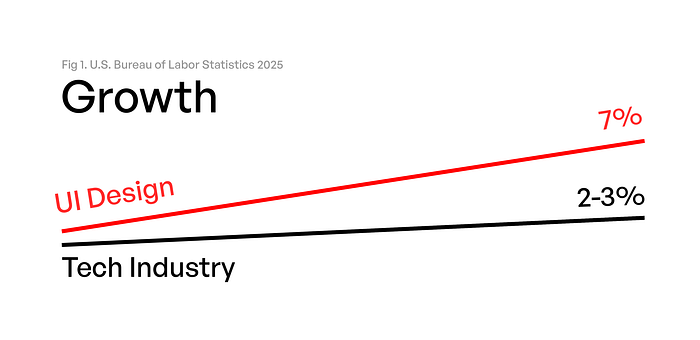
But it may not be the UI design you think.
I talked about some paths design is taking recently. Many people agreed. Some reacted with extreme aggression. That means the subject is sticky. I'm often provocative because I want to gauge reactions and see points of view. Then I combine it with local knowledge.
The more I talk to senior designers, juniors who are learning and examine my own experiences, the more I feel like the future is bright.
Blinding even. As designers we're in an extremely unique spot right now. One that puts as ahead of most "tech" jobs out there. It may even be THE job to pursue now.
Let me explain.
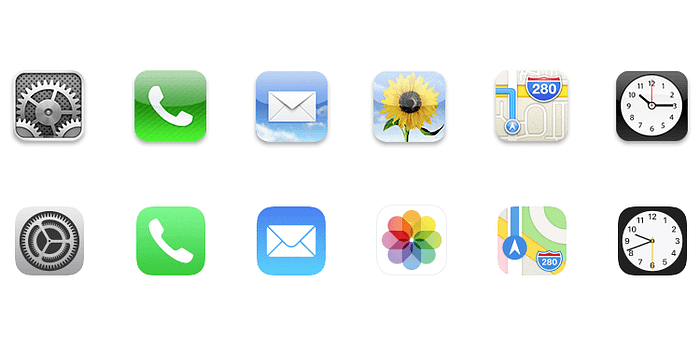
Skeuomorphism required not only design sense but also an artistic one
Design IS art. And then some.
First let's talk the most overlooked part of UI design. The artistic side of it. It was mostly forgotten once in 2013 everything went flat, and people without any design sense started stacking boxes with 16px spacings.
That made them believe they can do design, and led to all those misconceptions later on.
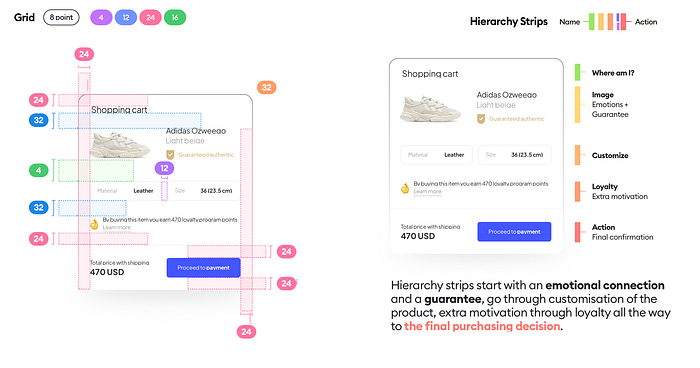
Design got simplified to easy, repeatable patterns. Anyone could do it. Not everyone should.
For years we've been told design is not art. But just like art, it requires a certain perception. An artist needs to see all the little details first, before he puts a brush to the canvas.
True designers are also like that.
Design IS partially art. Partially structure.
It's the emotional merged with functional. If you lean to far to the functional side, you go into the generative territory. Most of that side has no designer eye. No moat.
In 2026, with easier then ever building / generating workable ideas, that designer's eye is THE SKILL. It's your moat basically.
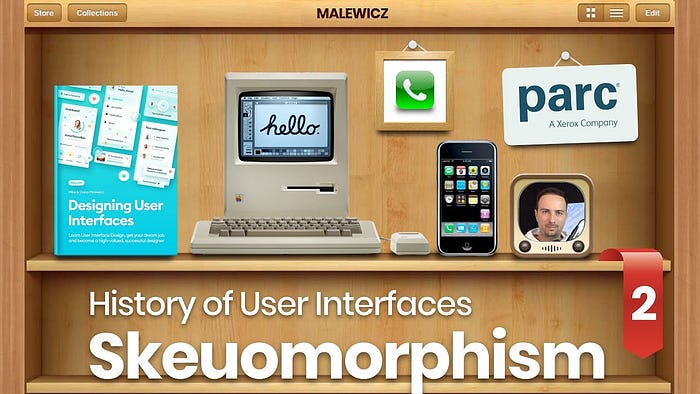
Skeuomorphism required a lot more visual skill than assembling colorful boxes
Averaging didn't kill design. Ever.
There's this fear, that AI "generative design" will put designers out of business. It's founded on the premise that those tools are getting increasingly better.
You can now generate whole landing pages with AI. Or a dashboard.
But this is nothing new. I started designing back in 1998. Around 2002 we already had a huge, pre-made template scene. So instead of designing a new site, you just buy a $20 template and adjust it slightly.
This saved a lot of time and back then people started saying that templates will put designers out of business. They didn't. If anything, they made the gap between a template and a tailor-made design even larger.
Designers had to innovate on both the visuals, the emotional connection and even technology.
Templates didn't kill design. It only separated the best designers from the mediocre ones.
It was exactly the same with UI kits and design systems. Another speed up of the product creation process, and design jobs were still on the raise. It also allowed for a lot of roles not requiring the design eye which I think was for the worse. This however, is now course correcting itself.

With the AI wave, it's going to be exactly the same. Design is one of the most unique roles in an organization. It adjusts with every market shift like that and takes over surrounding areas.
Designers are uniquelly suited to win no matter what.
Why? Because design has always been about adaptation and emotional connection of a user stuck between a problem and a solution. Or at least good design was supposed to be all that.
It got diluted a bit around 2014–2025 and is now in a process of healing. I'm excited!
Developers are cooked? Not really.
With development it's fairly easy. The overwhelming majority of products uses very similar code behind the scenes. Parsing data from a database, displaying a couple of forms and doing the calculations to show new data. The patterns repeat to a great extent inside products that are seemingly very far apart in terms of category.
A ride sharing app uses similar timeline techniques as your banking app and your pregnancy tracker.
Almost the entirety of backend and majority of frontend is running on the same, countable pattern loops. Sure, there is innovation and lots of it, but most of it takes years to get to consumer products. What AI parses with code is similar codebases.
Then it simply finds patterns and assembles.
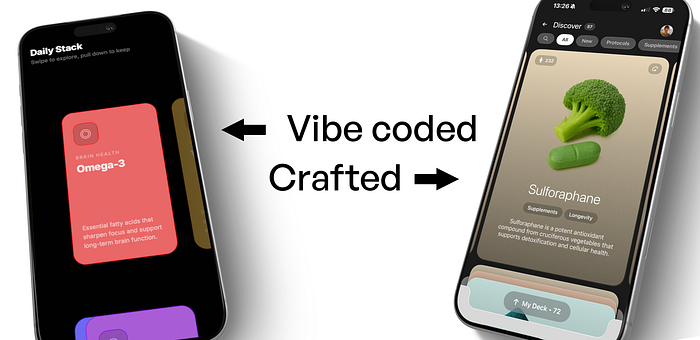
We may think that development is completely ruined now. Anyone can "vibe-code" an app nowadays. What actually happened, is a perceived templatization of code. Instead of paying a developer, you buy tokens, just like you used to buy coded wordpress templates in the early 2000s.
You have some limited control over it, but you don't have the skills for meaningful changes. You don't have the know how to secure it.
Big successful projects go out with gaping security flaws. They get exploited by smart people within hours. AI gave no-skills an illusion of building things.
In reality, it just speeds up the workflows of those who really know what they're doing. For everyone else it's a sandbox of templates.
And with design that difference is even bigger.
Designers are the future but…
We need to detach a designer from the tools. The crazy attachment is what's holding most people back. We imagine design is moving some boxes in a web app and pressing Shift + A.
For multiple reasons it's not, just as Auto-Layout is a terrible crutch for beginners. It's literally making them worse at design with pretend efficiency.

Many "designers" believe their work is assembly only
When your solution to arrangement is automatic, it means you lose the ability to understand the layout critically yourself. You don't consciously see the intricate details that form hierarchy and functional beauty. Instead of designers eye, you're training your fingers on shortcut that may be obsolete in a few years. Tools change.
When I was doing design education, many people didn't understand why I wasn't using Auto-Layout in my courses. It's simple. You need to feel the structure of a design subconsciously. And for that you need to understand why each object is in its place. You either train it or you lose it.
And once you train it, feel free to automate.

Generative dashboards require no skill to make
Design is…
There is a distinction between tools and experiences. A tool can be a complex system with dashboards, graphs, data presentations. Like many SaaS products nowadays. These rely heavily on design systems, consistency and functional clarity. The explosion of SaaS popularity led to the creation of a "Systemic Designer". The tools adjusted to it, quickly realizing that maintaining an ongoing-system is a great way to charge people more every month for tool access. Those tools started then promoting the idea that every product needs a systemic approach like that. Every little app needs design tokens, variants, documentation.
And technically it does work like that. But that still assumes design is just those boxes on the screen times coding feasibility times documentation. This is boring!
An experience is a smaller product. Doesn't matter if it's an app or a website. It may even have some kind of consistency guiding system. But the frontend is not all about that system.
It has some kind of a loop, an interaction pattern, a unique take.
Opinionated, emotional, human. It can use 90% of the same assembling bricks, but that 10% is what makes it memorable and fun to use.
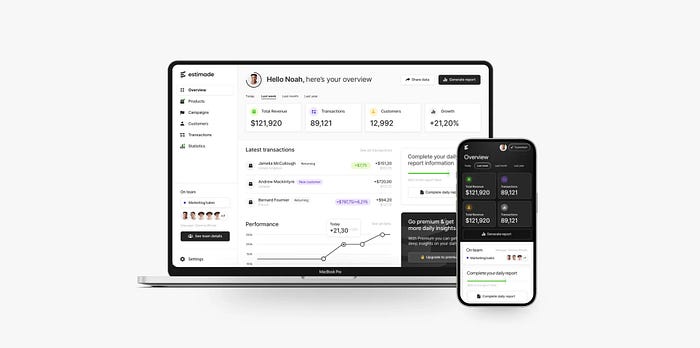
Everything looks the same, even if it looks objectively good
Wait! Automate the 90!
Now we're at a stage where assembling sets of boxes on a screen can easily be done by AI. It can inhale a design systems and exhale adjustable components. Already coded. Self documented.
AI is going to obliterate design system teams. As I said before, it will be like COBOL devs. Only a handful needed. Very well paid. If you love design systems, make sure to be in top 1–2% skill-wise. The rest will be gone within a year or two.
Hey! Didn't you say design has a future?
Yes. Just not systemic design. Conformity to strict rules and simple component properties are bound to be automated. This is not creative work. This is not solving problems. Maintenance of these systems will eventually be done much faster and better by tools, not people.
Once again, there is a shift in the industry where potentially a chunk of daily tasks gets much faster. Before it was templates, then dedicated UI tools, then UI kits, now it's AI.
With each change the designer role shifted and adjusted. But there are things that stayed unchanged.
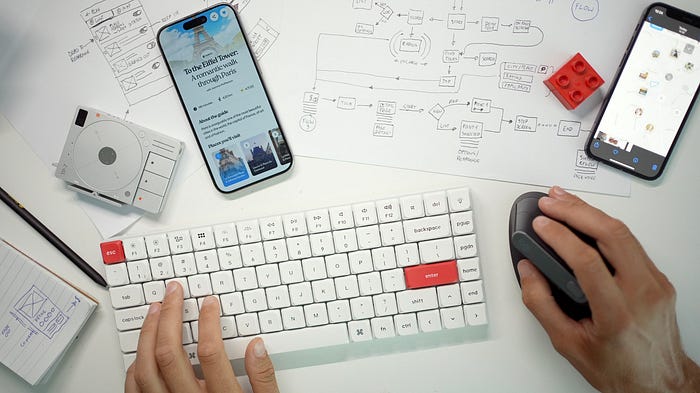
Designers should be multi-modal, curious and have a trained eye.
The designers eye is one of those things. The ability to look at a project and instantly see how to make it better. This has to be deeply ingrained with the love of the process. With the built-in nature of analyzing what you see. Breaking things apart. Finding patterns in the noise.
Another thing is curiosity. When design becomes a set of applicable paradigms, it gets boring. Our brains act on autopilot stiffling innovation. It's a tired trope now, but it's true:
When all you use is a hammer, every problem looks like a nail.
I fell into that trap too! When working on a huge, 1800 screen platform, with its own design system and 15 running device schemas, I started optimizing for time. Systemized design leads to this every time because the systems are in place to supposedly save time.
That happens sometimes, but in many cases you lose more money and time on maintaining a system than just running with a simple UI kit. Or an external DS.
I took pride in my ability to work on those 1800 screens all by myself. No team for a year. Being so fast that I could fix over a hundred views a day with a new feature by just modifying pullable components.
That was creative work lowered to a set of pre-made solutions.
If A than B. If X than Y. Repeat.

It becomes automatic after a while. You solve problems with the same solutions, not looking for new ones.
Disruption kills boredom
When a disruptive force appears, we're bound to change the patterns a bit. Shake things up. Rethink our approach.
By outsourcing the systemization to AI, we now have a lot more time to critically look at what we're building. And then, potentially how to either inject some soul into it (much needed in B2C), or find a new innovation pathway (both B2C and B2B).
Once we're not preoccupied with managing states of a radio-button, we have the mental energy to truly push things forward.
I know it's scary. It's a lot easier to learn how to use a system, and then for years drag and drop. Drag and drop. Drag and drop. Keyboard combination to arrange. Drag and drop. 5 PM approaches, sync changes. Log off.
Change is terrifying. Did you learn all that for nothing? And now the industry expects you to start thinking outside of the box? Do things you weren't trained for? No muscle memory?

2014 switch from Photoshop UI design to using Sketch. It was scary!
I get it! I was furious when I had to switch from Paint Shop Pro to Photoshop for UI design around 2004. Then extremely scared when switching to Sketch around 2014. Then… well… you know.
This is all about the division between designers and assemblers. If you're curious, exploratory, with a strong design foundation, you'd be excited.
We're only at the beginning of this shift, and I'm already seeing multiple avenues in which a real designer can thrive!
Interactions and soul
For years most products were limited to simple "scale on hover" and "draw the dashboard graph" interactions. They were simple to code and came out-of-the box with most design system templates.
Now there is absolutely NOTHING holding you back to prototype more unique interaction patterns. This can be system-wide, or as simple as what happens on a button press.
When AI generates an interaction, it uses that safe systemic knowledge, because it needs it to logically predict the next step. I tested it by generating a colorful deck of cards with a swipe-down to deck interaction.
Because I've seen a lot of generic examples of nearly every UI interaction before, I was able to visualize what this will look like before AI even made it. And I was absolutely right!
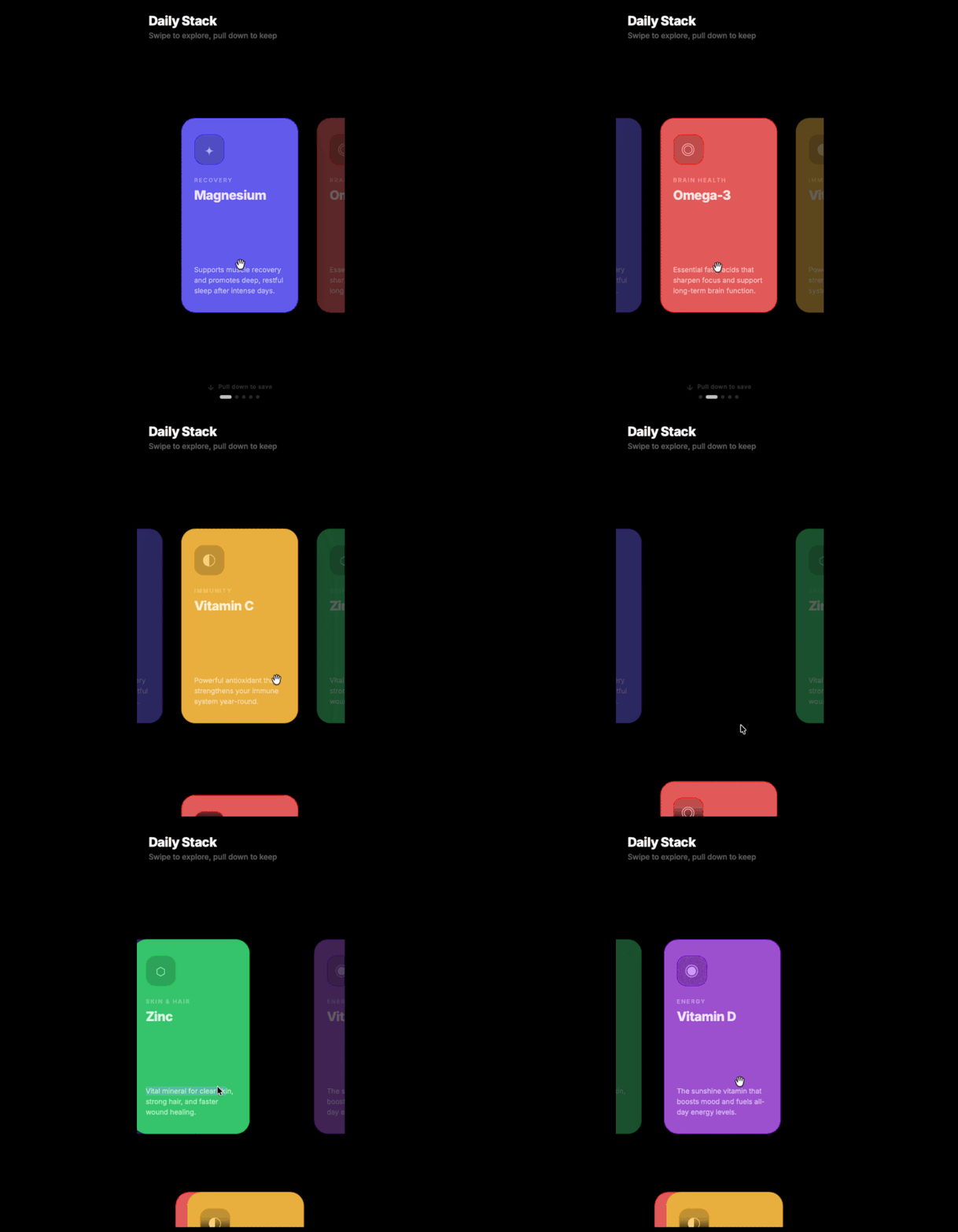
AI "vibe coded" card stack
Sure. The carousel was there. You could've swiped down to add to the deck. But the entire behavior of the UI felt cheap. Non-refined. Generic.
I scratched it and restarted the process. This time using precise, machine-ready language and constant tweaking.
The 13° forward tilt should reach its peak at 20% of drag length, starting from 0° tilt. Drag release finishes the animation with an ease-out curve. Calculate the remaining curve using drag-release position. The bounce level at the bottom should be directly proportional to when the drag gesture was released. Place card on top of the stack, then shift it down, while simultaneously shifting the cards behind up with a 5% bounce.
Then I kept recording my screen during that interactions. Watching the resulting recording frame by frame. It looked really good almost immediately but did it feel right? I kept tweaking it down to a single pixel movement.
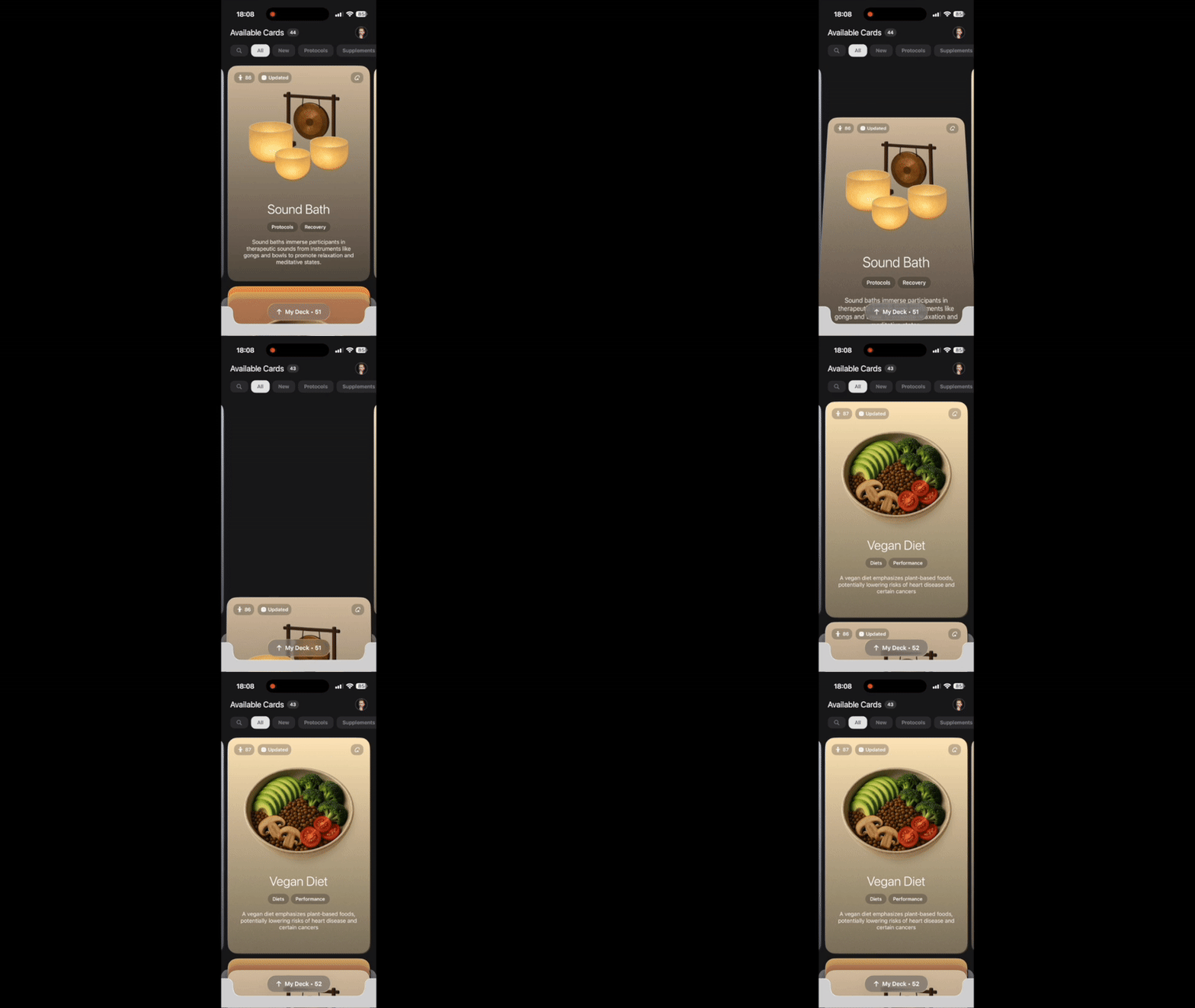
The end result is one of the reason my app is so beloved amongst the users. They see I poured my heart and soul into a product. And when that is visible, it resonates.
In my other app, I added the app mascot (polar duck) to float on a cold ocean surface in the direction you tilt your phone. This unnecessary detail turned out to be so delightful, 100% of testers said they love how unique the app feels. They felt a connection to a bunch of pixels because patterns were broken without making the experience unusable.
You don't have to limit yourself to tested, predictable things. If an app is about ice baths and cold swimming, having a blue and purple gradient with a profile circle at the top would be boring. Exactly what a systemized approach would suggest.
How about an iceberg, slowly floating on the water with your face visible through a hole in it? These interactions feel genuine, human and fun because they were designed. Not assembled from pre-made component sets.
Delightful Conversion
We already patternized CRO beyond logic. It seems like most of online sales are about getting the sale in. Not many however are focused on emotional responses.
I call it delightful conversion.
When you form an emotional bond with the user, they don't just become a row in your profit sheet. They become an ambassador of your brand. That is long term value that's mostly being left on the table.
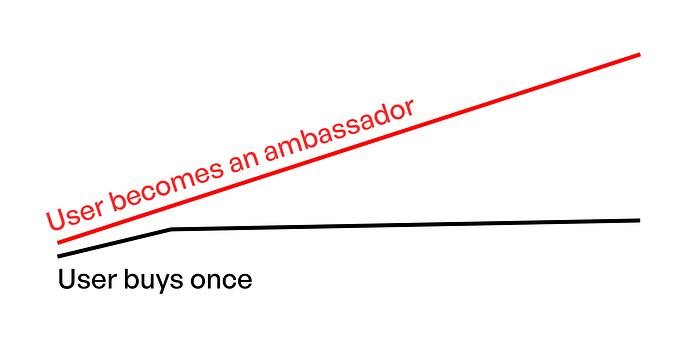
When a user buys something once, you get the money but that's it.
It's also another opening for designers. How to form those emotional bonds with users in an ethical, fun way. It has to be a win-win situation for both sides. That goes in almost direct contradictions to most of cro's dark patterns and deceptive designs that exist today.
This will happen through empathy and creativity combined. Designers understanding copywriting can design the message for maximum resonance.
With a high quality product or service as a base, there's extreme potential here to grow as a designer. Find a different kind of "sticky" product. Not one that gets people to reach for their credit card, but one that gets people smiling when interacting with it.
That of course requires research. Empathy. Will to break the rules or at least bend them. And a focus on the quality of the product, service around it, every step of the way. Add a sprinkle of delight on top and you're there!
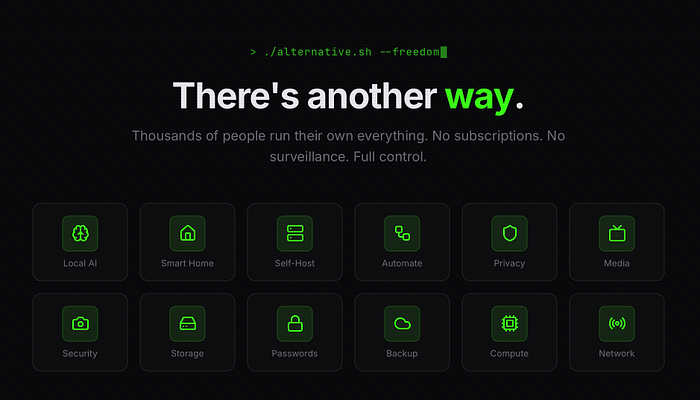
Tinkerer Club uses "writing out terminal commands" in sections.
That delight can be anything. If you've built a product around terminal tools, it makes total sense to create message matching "fake" terminal commands being written out for each section. This naturally connects with the audience. They chuckle. They nod. They're sold!
This goes along with the next one well.
Ocean of sameness
Systemized design has already created what I call an ocean of sameness. When looking at dashboards posted online, it's hard to say which one is for which product. Everything looks the same.
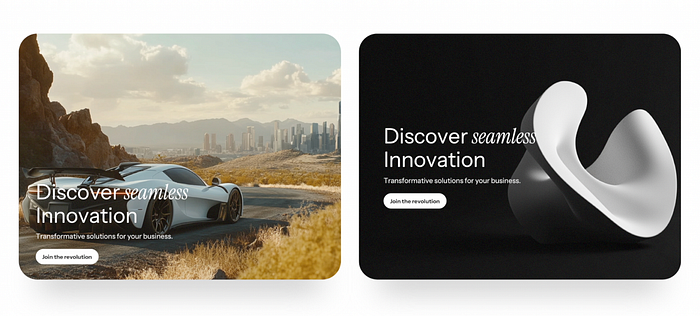
True ocean of sameness. And lack of personality.
Adding AI slop on top of that combined with the ability to mass generate content has a very predictable outcome. Complete and utter oversaturation of the market with sameness.
This in turn will overwhelm the users and greatly decrease their base level of trust. Where you think you're optimizing by "one-shot-prompting", you'll end up causing fatigue.
That fatigue is already at an advanced stage and the progression from here will be exponential.
There are specific patterns and tropes that AI constantly repeats that add to that. The box in a box with an icon.
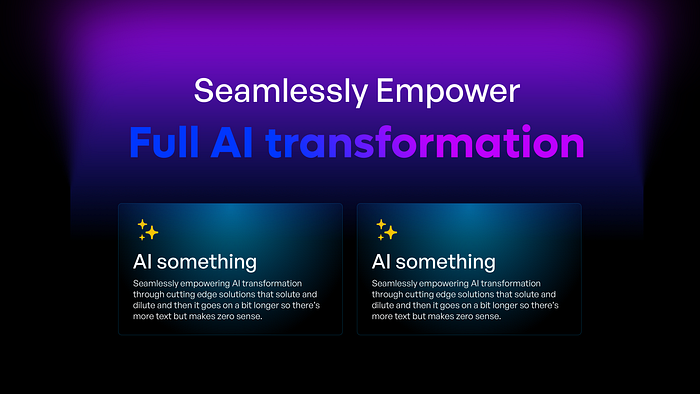
SLOPified ai design tropes
The blue and purple gradient on thick type. The radial gradients on a grid of boxes. Or a 100% generated background image that screams "SLOP".
Spotting these overused generative patterns and going the opposite way is going to be an extremely useful skill. Otherwise your project will just drown between 5427 identical sets of components.
Human connection
In all those templates, boxes and random gradient blobs, there is one thing that's missing. A person.
We naturally connect emotionally with other people. And people have now become brands. But humans are not easy to put in generic boxes. For the most impact they require to be added organically. Or with some kind of twist.
Curation of real photoshoots and creative ideas for them will also be a huge design win in the years to come. With all the progress in generative images, they are still not having the same effect on viewers as real photos.

Curated and art-directed design always wins. (source: Opal Camera)
Personality in its literal form is returning big time. We're sick and tired of animated gradient blobs and generic copy. Just like on a call center call, we want a human! And we want that human NOW!
When great photos are merged with a quality product and amazing storytelling magic happens. And that kind of magic requires the exact curiosity, good eye and creative direction. Not a prompt.
Generative vs Real World
A 2025 study called the Remote Labor Index tested AI agents on 240 real freelance projects on sites like Upwork. It ranged from game development, product design, architecture, data visualization and writing. It's the actual work humans get paid for.
AI did one project, a skilled human did his own version of it. The results were shocking!
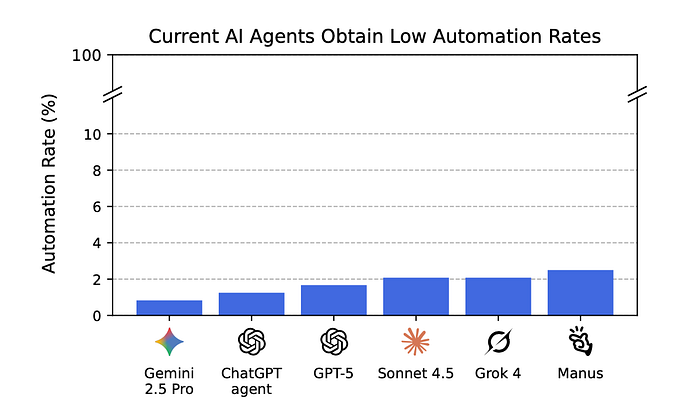
The best AI agents automated just 2.5% of these projects. While AI performs well on some obscure software benchmarks, it collapses when faced with end-to-end creative work requiring judgment, taste, and context. It faceplants itself. Hilariously bad!
The study found AI struggles most with design, operations, and creative production. That is exactly where human intuition and soul matter. This is why designers who inject personality, break patterns, and create emotional connections will dominate the next few years while AI remains stuck assembling boxes.
It may get to emulate that eventually, but so far it's just going deeper into the assembler rabbit hole.
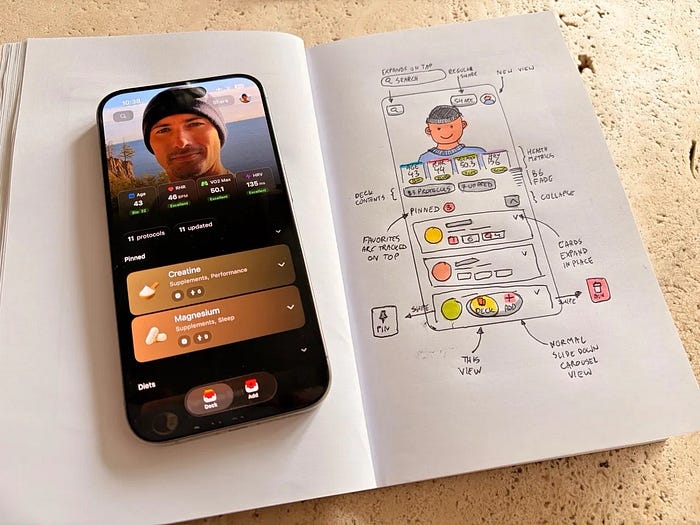
A lot more design will also be happening on paper to show clients there IS a process behind it.
Design 2026–2030
I generalized it slightly under the UI design umbrella. I know.
But in a way, most of what people use right now is some kind of an interface. UI design sweeps it up nicely and combines into something that's interactive.
User expectations will be higher when market gets oversaturated with mediocre, identical looking products. Generative AI simply made the templates of the past happen even faster.
But to build truly groundbreaking products in the next few years it will require a special kind of person.
A designer.
What's Your Reaction?
 Like
0
Like
0
 Dislike
0
Dislike
0
 Love
0
Love
0
 Funny
0
Funny
0
 Angry
0
Angry
0
 Sad
0
Sad
0
 Wow
0
Wow
0


