


![[VIP] Unlimited Pass 2026.02.26](https://i.pinimg.com/1200x/d2/f8/2e/d2f82e903b9ca33b0f13704cc85a3d8a.jpg)
![[LS] ls.graphics Pass 2026.02.16](https://i.pinimg.com/1200x/8d/ca/7f/8dca7ff72d8b698f955649340d0ff398.jpg)

![[PRO] Craftwork Pass 2025.06.11](https://i.pinimg.com/1200x/98/d2/f0/98d2f0169226b431f4727441ecc6aa06.jpg)


![[VIP] Creovo: Creative Portfolio](https://i.pinimg.com/1200x/92/5d/39/925d39b614ae4e39adda25b73837f82b.jpg)
![[VIP] HeanAI: AI-Chatting Dashboard](https://i.pinimg.com/1200x/fe/a3/39/fea339dffb21b585ca014916e20186b7.jpg)
![[VIP] Eventverse: Event Organizer Framer](https://i.pinimg.com/1200x/5c/c0/2a/5cc02ad5be57bcf560611178f9914a58.jpg)
![[VIP] Fuchsia: Web3/SaaS Framer Website](https://i.pinimg.com/1200x/36/6c/37/366c371285f13531caf2077c599fa1cc.jpg)


![[VIP] Voltz: Electric Car Website Template](https://i.pinimg.com/1200x/03/ba/41/03ba41513483727fcd26b95349750783.jpg)
![[VIP] Zyra: Coded Chat AI Dashboard](https://i.pinimg.com/1200x/ce/7b/92/ce7b926f22423fc046659dfe1dd7a604.jpg)
![[$] AlignUI: Code Library](https://i.pinimg.com/1200x/8d/91/1c/8d911c0a22483842cff69c130e80c37b.jpg)

![[VIP] Solaris: Sales Forecast & Pipeline Review Deck](https://i.pinimg.com/1200x/ba/7c/48/ba7c485ac40a51054cf9074aead204e2.jpg)
![[VIP] Brand Guideline Presentation](https://i.pinimg.com/1200x/64/87/a7/6487a7c4da21072150a1664f83a6a234.jpg)
![[VIP] SaaS Pro: Presentation](https://i.pinimg.com/1200x/d5/75/dc/d575dc20daed5af02a08ed54d53ce7f5.jpg)


![[LS] iPhone 17 Mockup](https://i.pinimg.com/1200x/18/42/c1/1842c11e3da971765bdcfbc5315f3df8.jpg)
![[LS] iPhone 17 Pro Max Mockups](https://i.pinimg.com/1200x/f0/2a/72/f02a724ed9f52ac4a1c66b5614809111.jpg)
![[LS] AE-Mockups, Apple Devices](https://i.pinimg.com/1200x/03/04/9b/03049ba79acaa546ae6389639f89bcc1.jpg)
![[LS] MacBook Air M2 Looped, Animated Mockups](https://i.pinimg.com/1200x/76/d9/0a/76d90af27052b69cb561a098cd1907a6.jpg)


![[VIP] Volnitsa: BLNDR MINI (2025)](https://i.pinimg.com/1200x/c3/f7/0a/c3f70ae1126be5c0af1977e58b56ba7a.jpg)

![[VIP] Growth: The Psychology of UI Design](https://i.pinimg.com/1200x/3a/d1/b5/3ad1b5e63efe17451a16013591bcf519.jpg)


![[VIP] React Three Fiber: The Ultimate Guide to 3D Web Development](https://i.pinimg.com/1200x/78/02/1f/78021ffdfc8113cc8caba5b2c563ead4.jpg)
![[VIP] Ryan Hayward: Ultimate Framer Masterclass 3.0](https://i.pinimg.com/1200x/48/d6/3f/48d63f9723d7c49e6c34c182557c7431.jpg)


![[VIP] Whoooa! 156 vector Lottie animations](https://design.rip/uploads/cover/blog/whoooa-156-vector-animations.webp)


![[VIP] Staff Product Designer (ENG, RUS)](https://i.pinimg.com/1200x/0c/52/a0/0c52a08d8b0a25329806437933cf538f.jpg)


![[VIP] Products People Actually Want](https://i.pinimg.com/1200x/4e/aa/f9/4eaaf9c3961559a9bba223a33c5e6d19.jpg)


Human Designer vs Google's Vibe-Design Tool
AI can design now, but how good is it compared to a human design?
Google dropped a new, AI powered, vibe-design tool. And every time new AI tool drops, the bots are at it again. This time all over X, LinkedIn and other platforms all you could see was:
Designers are Cooked!
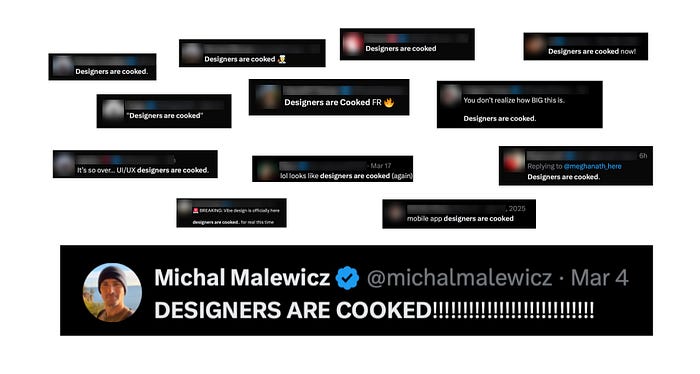
Of course my post here is just a joke.
Before I get to the actual design comparison, we need to talk about two important things.
Who are the "cooked" people?
I searched for "Designers are cooked" on X and found hundreds of profiles sharing that phrase alongside Google's Stitch AI announcment. So I did a little digging based on 25 profiles with the largest reach.
Can you guess how many of them were designers?
Zero. Not a single one of them had any design background. Most of the AI generated things they shared on their timelines were complete slop.
So why are they saying this?
Easy. The first thing is clickbait.

These people are sharing "design" like that and saying it's great.
Designers are one of the last groups that was still impervious to AI. So of course if someone feels like their design position is threatened (and it sometimes really is) they will react. Boost the post. They get views, clicks, attention.
But I think there's one more motive.
They are subconsciously aware they can't design, and that they have no taste. So they want to downplay design to these AI generative templates just to feel better about themselves.
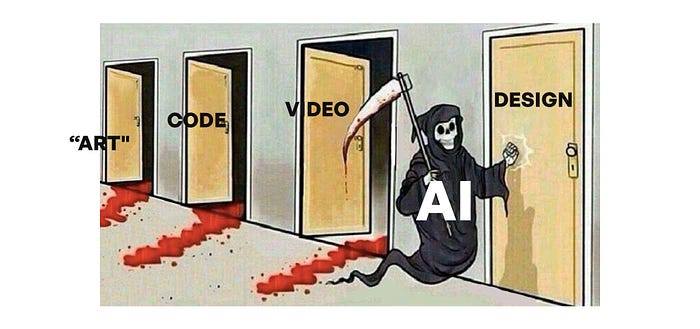
AI is taking over everything
There is also the argument that AI already took over coding (not true) and is taking over video (also not true).
As examples we see vibe-coded slop apps that have zero users, are extremely easy to hack, but at least someone with no coding knowledge built that. Sure. Yeah. And? So what?
With videos I often see hollywood style cinematic things shared saying filmmakers are cooked. But who do you think made those videos?
Actual, talented filmmakers with taste. They knew what to prompt AI exactly, they understood the scene sequences, framing, lighting, camera work.
Same with design.
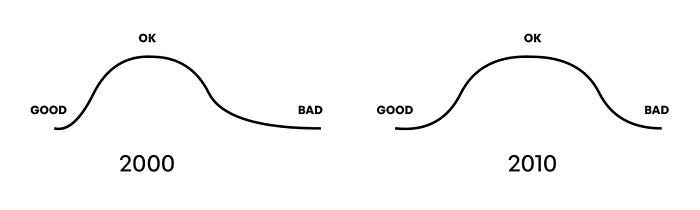
There were a lot more bad designs in 2000 than in 2010 but…
The bell curve problem
The easier the barrier of entry to web design (and later app design) became, the wider the bell curve of design quality became. At first it was leaning one way, because making good web design was incredibly hard.
But it has switched directions and evened out around 2010. However, instead of moving more towards more quality products, it stopped and started inflating.
In both directions.

Now there's a lot less good and bad, but a lot more average. And that's not a good thing.
Which means we now have very few extremely bad websites. That's good news. Templates, UI kits, more designers and now AI all led to extremely bad design being very rare.
But it didn't spawn actually amazing designs. They are just as rare. What it did was inflated the median. The middle of the curve. The average.
And that started happening way before AI, it just got accelerated with it. For years people tried to copy what others did, and the most popular design directions became tropes that slowly faded into obscurity.
And AI trained on that average. Of course specific AI design tools were tuned with more good design, so what AI does now is slightly shifted to the left, but not by much.
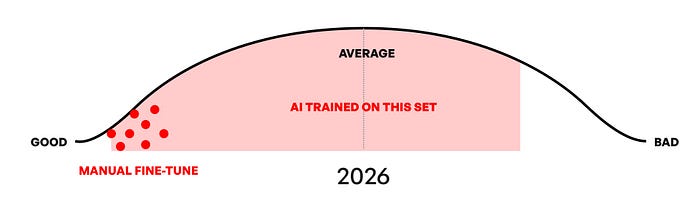
That's because an actual great design, one that helps a business sell, is not a template made from a design system. It's not a set of ai generated filler images and basic copy. It's thought out to the smallest detail and it happens to answer a specific problem. That can't be generated still.

Of course it HAD to use purple and blue ;)
Here's Microsoft Desi… Google Stitch
But clickbait aside, Google Stitch is pretty interesting.
My goal was to see how it would build something I already created. My app called Longevity Deck. So I prompted it for exactly that. Tried to keep the prompt specific, but not jargon-filled.
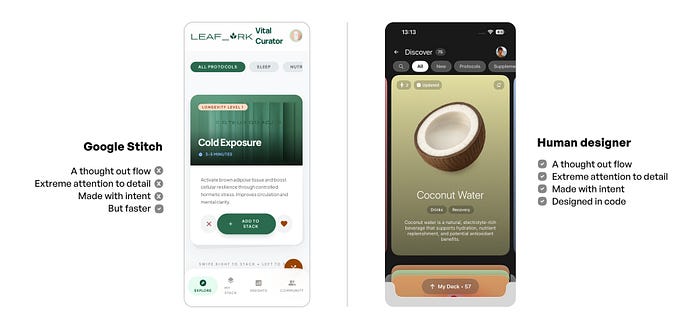
Google Stitch vs Human Designer
My goal wasn't to show how a designer would use a tool, but rather a regular health enthusiast that wanted to make an app with longevity protocols.
Design system
It starts with a design system. And when you go look into the example apps and prompts, and then see your own prompt come to life, you realize it all looks the same.
Those design systems are basically almost identical. Looking like Material Design, Tailwind and Shadcn had a baby. There is some variety, but not much. It lacks any uniqueness.
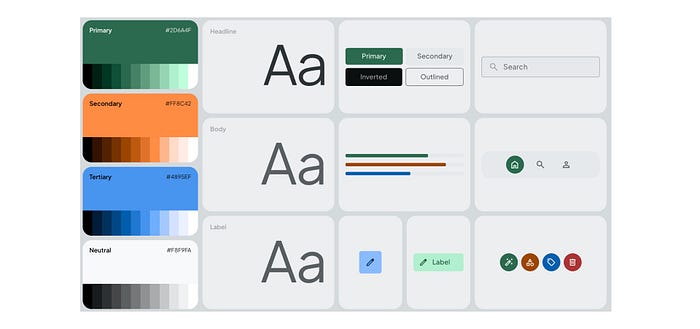
The design systems all look practically the same. Boring. Predictable.
That's to be expected, because an automatic tool needs some rigid rules to be able to build something out of the blocks.
When building B2C apps, the first parts of the work are almost never a design system. Instead they're style and idea explorations, without components, naming layers or systems. Then, when we have something that speaks to the audience the right way, we systemize it from there.
Many of the ideas start on paper and then get refined.
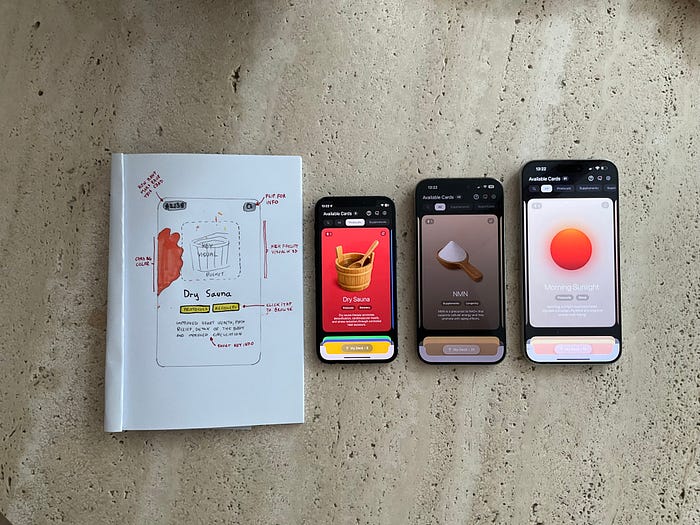
The original app started on paper and that allowed for a proper exploration.
AI currently can't reverse that process and just propose something. It desperately needs those blocks.
The app
At first glance the app doesn't look bad. This is why many non-designers may be excited. A nice mountain lake for cold plunge illustration, with a glassmorphic category badge. Nice!
But when you look closer both the UI and the UX starts to fall apart.
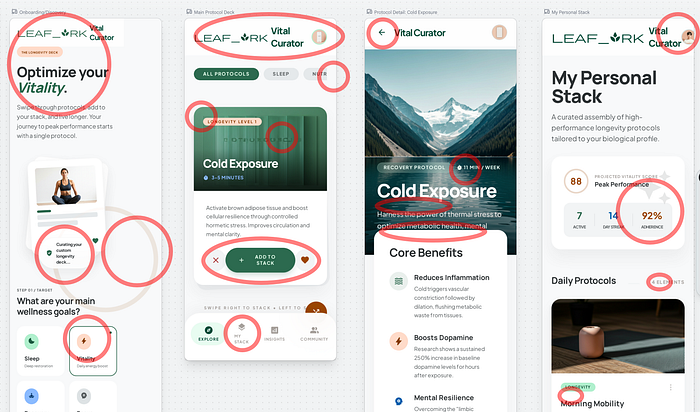
There's more bugs in this, but I left some of them for you to find. And a lot of flow-related mistakes that don't make any sense.
Weird spacing and hierarchy of text. Some content doesn't fit the containers and breaks. Odd color choices. And that generic, template style on top of that.
The app itself also doesn't make a lot of sense functionally. It uses some tropes like a dating-app swipe left and right, but it has no idea what's going on. You can clearly see it by having more content under the main swipeable container.
Since it's the main action, why do you have something more to scroll to?
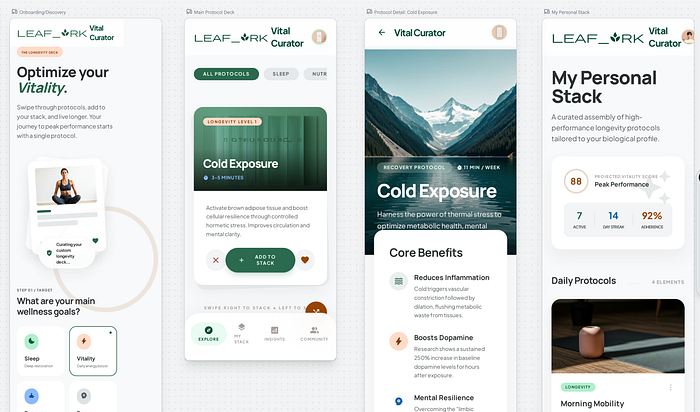
And now let's take a look at the original app. The attention to detail down to the single pixel (which is 0.3 pixel in code) double borders, special dropshadows to simulate card depth and a noise texture.
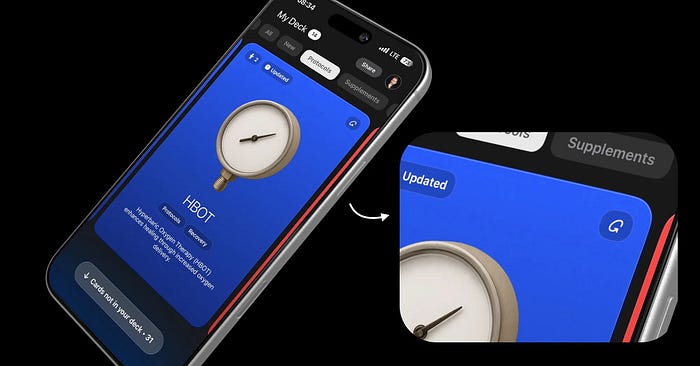
And that's before we even talk about the interactions! Everything in the app is crafted. I worked on the swipe to deck animation by coding it, then recording and watching the videos frame by frame. It took 63 attempts to get this right.
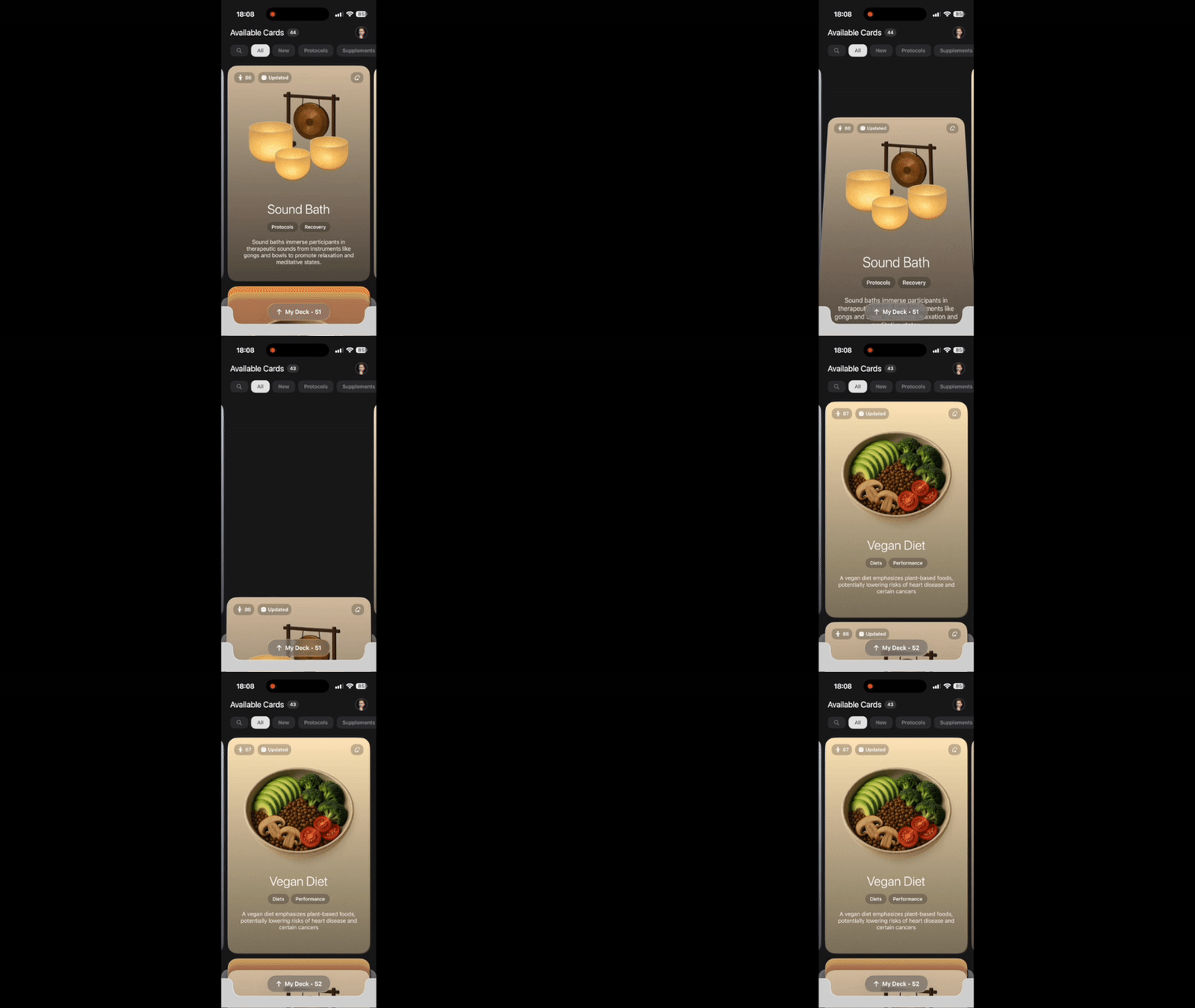
But if you tweak it…
When I posted my thoughts with these examples on social media, many people said it's a good starting point. A source of inspiration.
Let's dismantle those two arguments first.
If this is a source of inspiration for you, it means you're fine with being inspired by the average. I still think, a person with any taste will find more inspiration on Dribbble by manually going through the feed.
It's like saying you're inspired by Shadcn. It is a cool, robust library, but inspiring is definitely NOT the word I'd use to describe stuff built in it.
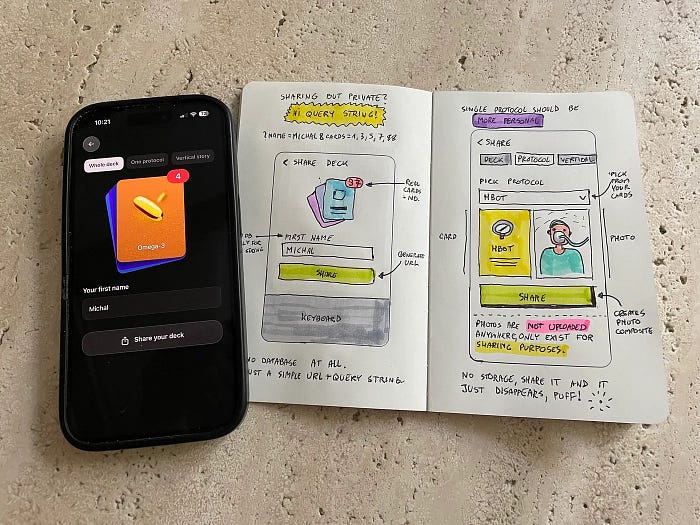
Best design starts before any prompt boxes or pixels.
And if you need a starting point for the flow or app structure, it means you haven't already sketched out a flow of the product. These things happen before any design is made, and they answer all the questions already.
With that you KNOW what you will design. You can then prompt AI (if you have to) or drag and drop some UI components and build it out.
If you start with AI to give you ideas for the flow, it's even worse than with UI. It means you're outsourcing the main purpose of design, not the grunt work.
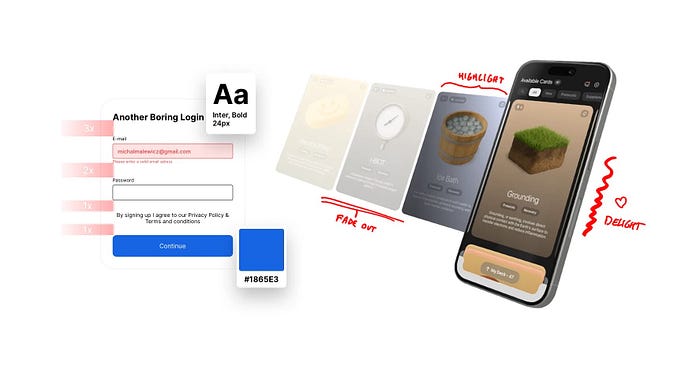
Most non-designers will accept whatever AI gives them.
A design tool for no one?
Stitch marks a new era of AI UI generation. It shows that it can assemble design system based blocks well enough for someone capable to tweak it later.
Which proves my point that design system people have the most to fear. This kind of work is what AI is learning very fast. It's not fully there yet, but Stitch shows it definitely will be.

If you only assemble blocks, then AI can replace you.
But it's a design tool for people who are not designers. Which means they won't KNOW if the result they got is good or not. They'll have to trust the AI judgement.
Sometimes they may get lucky. Some other times they may get a complete failure and accept it as good. Then have their business idea fail for apparently no reason.
Free is pretty expensive
If you're building a website for your non profit club that plants trees, then by all means this tool will be great. Or just use any other AI code tool and ask it to code it right away.
The results will be average. Good enough.
But if you're a business of any kind, it's a lot different. If you're selling products or services, you may be tempted to make a "Free generative website".
The problem with it isn't that it will necessarily be bad. It may be right in the middle of the bell curve. The most average of averages.
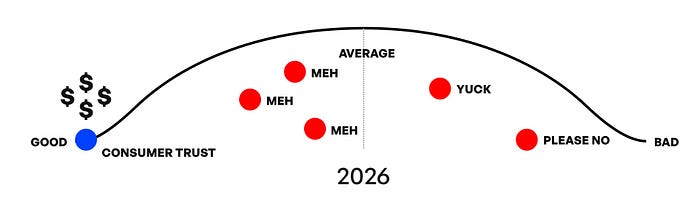
When everything's average, consumers tend to pick products that show someone made an effort.
But when everyone's average, who is getting the sales? The not-average ones. The ones where the craft, attention to detail and love of their business shows clearly.
And the more our little bell inflates, the less of those will be there. And I believe they will gain the most from all that. Whether they use AI or not, they will be people who have taste and who make things consciously.
Not just typing something into a box and hoping for the best.
What's Your Reaction?
 Like
0
Like
0
 Dislike
0
Dislike
0
 Love
0
Love
0
 Funny
0
Funny
0
 Angry
0
Angry
0
 Sad
0
Sad
0
 Wow
0
Wow
0


